
Coming off a brutal 2-3-0 road trip through the eastern side of North America, the Calgary Flames limped home embroiled in trade speculation. For the four days going back to a 5-3 loss to the Blue Jackets on Jan. 13, insiders had been reporting that a Rasmus Andersson trade was imminent.
The 29-year-old defenceman and his team endured the noise as the group found themselves back in Calgary for their first home game in almost two weeks. In one final send-off, Calgary’s home-grown offensive blue-liner got a chance to say goodbye to the the only city that he had played for in his eight-season NHL career.
In spite of the awkward situation surrounding his future, Andersson recorded a primary assist on Calgary’s first goal; his last point as a Calgary Flame as the team surged past the New York Islanders to a 4-2 finish. The Malmo, Sweden product was finally traded two days later to the Vegas Golden Knights.
The Flames haven’t won a game since.
While fans in Calgary have seen stars depart; Matthew Tkachuk, Johnny Gaudreau, Elias Lindholm, Noah Hanifin all found new teams in the last four years, Andersson’s departure signalled the final high-end player from the 111-point, 2021-22 squad that reached the second round of the Stanley Cup Playoffs.
0-2-2 in the post-Andersson era, there is a staggering difference in this new iteration of Flames hockey. While we only have a four-game sample size to work with, here are six trends surrounding a team that is now adapting out of necessity.
Trend #1: Stifling Starts
If you’ve been watching the Flames over the past eight days, you may have noticed that the start of games have been painstakingly low-event. Three of four games have featured both teams combining for only one shot on goal in the first five minutes.
Examining the immediate difference let’s look at the four games prior to the trade versus the four games after.
Average shots between both teams in first five minutes of regulation
Four games before the Andersson deal: 4
Four games after the Andersson deal: 2.5
That stat may not seem like much, but only two and a half shots between both teams over five minutes is low. Three of the games featured only one shot between both teams in the first five, and the Capitals game (7) pushed the stat into believable territory.
We saw the Flames were already keeping their starts low-event. Now they’re leaning into it to the point where you can feel safe in running late to the game.
Trend #2: A Perfect PK
Let’s do the same for Calgary’s penalty kill.
Assistant coach Trent Cull has run a tight crew this season. Despite sitting in 29th place in the standings, their 83.7% PK puts Calgary tied with Toronto for fourth-best the NHL. Better than contenders such as Carolina, Edmonton, and Vegas.
Since trading Rasmus Andersson, the team is a perfect 100%. Small sample size, so four other teams have a PK running hot enough to keep pace with their perfect kill rate.
Trend #3: There is an offensive vacuum
This goes beyond just putting the puck in the net. The Flames are floundering in transition. Zone entries and exits have been sloppy, and goals are more luck-dependent than most would prefer.
During the last four games of the Rasmus Andersson Goodbye Tour, the Flames were scoring a respectable 3.00 goals per game. Since then, their six goals in four games has them scoring at an unsustainably low 1.50 goals per game. It goes without saying that their 0-2-2 record since the deal is largely in part due to their flickering offence.
Trend #4: Discipline is back on the menu
Over 48 games prior to shipping Ras to Vegas, the Flames averaged 4:30 of penalty kill time and 3.02 times shorthanded per game.
Since then? Those numbers have shot way down. A solid average of 2.00 instances shorthanded per game and an average of 3:18 of PK time through four outings.
Trend #5: The third period is no longer their friend
Once their most identifiable strength, the Flames have been outscored 5-1 in third periods through four games post-Andersson trade.
Last season, the Calgary Flames had a strong identity of late rallies—to the point where they nearly made the playoffs primarily based off stealing points late in games.
Goals by Period: 2024-25
First: 55 (31st)
Second: 67 (29th)
Third: 93 (10th)
We can’t say the same for this season’s iteration of the Calgary Flames.
Goals by Period: 2025-26
First: 41 (21st)
Second: 42 (32nd)
Third: 45 (27th)
There may be lingering improvement in that regard. Here is how the team looked a calendar year ago on Jan 26, 2025.
First: 30 (32nd)
Second: 45 (21st)
Third: 51 (17th)
Similar numbers to last season aside from their terrible first period habits. The Flames finished with a push that had them scoring 25, 22, and 42 goals in the first, second and third periods respectively over their final 34 games. 42 third period goals ranked the Flames tied for fourth in that category down the stretch. We’ll see how they look after the Olympic break.
This is a long way of saying that the Flames had a strong identity; it faded significantly this season, and has been non-existent since the Rasmus Andersson trade.
Goals by Period: Four Games without Andersson
First: 3 (T-15th)
Second: 2 (T-25th)
Third: 1 (T-27th)
Small sample size, but anyone watching these games can tell that the team is has lost something. They’re playing through that unspeakable absence and slowly starting to fill the void left in Andersson’s departure to Vegas.
On that note, one final trend.
Trend #6: Younger players are stepping up
Six goals in four games and 1.50 goals per game are both unsustainably low figures; a clear indicator of a cold streak.
With that said, production is starting to come for a few key younger players. All 24 years old or younger, Matvei Gridin, Matthew Coronato, Connor Zary and Hunter Brzustewicz have been involved in five of Calgary’s six goals since Rasmus Andersson was traded.
For those clamouring for more deployment for the next wave of Calgary prospects, that is excellent news.
Looking forward
The Calgary Flames are likely going to keep leaning harder into their identity as a low event group. There simply isn’t enough talent on the roster to play river hockey with the high-end talent scattered across the NHL. 32 players currently sit at 2.00 points per game against the Calgary Flames this season. Take away one-gamers and you have 10 players that have played at least two games against Calgary and have recorded two or more points per game.
Six of those ten were selected in the first four picks of their respective draft year. Jack Eichel, Connor McDavid, Connor Bedard, Leon Draisatl, Macklin Celebrini and Mitch Marner.
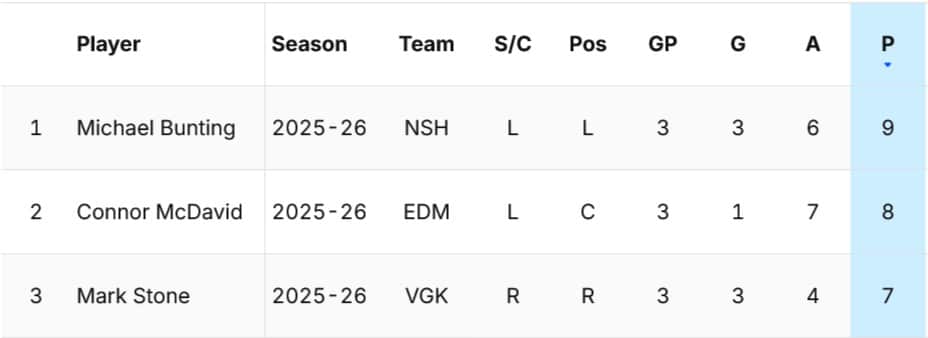
A bit of an anomaly, Nashville second line forward, Micheal Bunting, leads all players in points against the Flames with nine (3g, 6a) in three games. 31.03% of his 29 points in 25-26.
In 29th place and on course to draft their own potential superstar at the 2026 NHL Entry Draft in June, there are still reasons to tune in. Who steps up in this current offensive vacuum? Do we see this trend of younger players running the offence continue? Will Nazem Kadri once again surge down the stretch? Will more trades happen and, if so, who gets the next tap to join the Flames roster?
That’s the joy of professional sports. Every day is another page in this unique, current chapter of Flames hockey.
Statistics courtesy of Natural Stat Trick, Cap Wages, and the National Hockey League.
Keep Reading:
6 Quiet Truths Behind the Rasmus Andersson Trade to Vegas
Rasmus Andersson Trade Looms: How Good is the Player?
Tap of the Stick, Whack of the Pads: Flames Call Up William Stromgren
Follow on X: @Trevor_Neufeld
Looking for discussion? Check out our forums section and weigh in on what’s happening around the NHL!

Thanks Trevor.
It’s going to get even worse once Kadri, Coleman and Weegar are traded. Flames should be focused on a top 3 pick, anyone of McKenna , Stenberg, or Verhoff will go a long way in helping rebuild the Flames. It’s finally an exciting time to be a Flames fan again.
Thanks Trevor!
Hey Kman!
You think all those vets get traded? Unless he wants out, I cannot see them trading Coleman.
I had always believes Weegar would be the next captain but he just seems miserable.
I heard today Kadri is open to getting traded. Best news I have heard this year 😎
Quiet on here. It would appear Huberdeau is done. 👍🏼
It would.. I wonder how long that had actually been an issue..