20 years ago, fresh off their silver medal in Salt Lake, the U.S. men’s hockey team entered Turin with medal hopes, but ran into international legend Arturs Irbe in net and ended up with a 3-3 tie.
That lack of success at the start stung the Americans, who won just one of their next five for an eighth-place finish.
Coming into this year’s tournament, the U.S. is one of the medal favorites, particularly after a second-place finish at the 4 Nations tournament last February and a number of players who won gold at the World Junior Championships in recent years.
The Latvian lag seemed to be an issue early, as while the U.S. struck early for a lead, a follow-up goal was negated by an offside replay, which was followed up quickly by a Latvian tally. Another go-ahead goal was wiped out by goaltender interference, and the U.S. added a pair of posts. Despite having an edge in play, the Americans were tied after 20.
But the U.S. left no doubt in the second period about their talent level, outshooting the Latvians 17-2 and at times literally leaving the maroon-clad team gasping for air after a dominant period. Brock Nelson, whose uncle Dave Christian won the last U.S. gold in 1980 and grandfather Bill won the 1960 gold – and whose jerseys the current edition models now – scored a pair of goals, including the important go-ahead goal in which he emphatically pointed at the net to show it counted, and the rout was on.
For the United States, while Canada isn’t in their group, there already is a race for the goal-differential to determine the higher seeds once the preliminary round ends. Like Canada, the U.S. should manage to go the first three games without a loss, and so the goal-differential will determine which team gets the slightly easier road to the gold medal.
Sweden and Finland, the other two teams considered medal contenders heading into the tournament, had tougher first games than anticipated, and with the Finns losing to Slovakia, they are pretty much eliminated from the race for the highest seed. Those two rivals meet Friday, and should Finland manage to top Sweden – or even push the game to overtime – it seems like the Americans or Canadians will end up with the top seed.
After one game among the medal favorites, the Canadians have a +5 goal differential by virtue of their shutout of Czechia earlier Thursday, with the Americans one behind with their win, and Sweden with a +2 after a surprisingly close win over Italy on Wednesday.
Nelson, who was on a tear with the Colorado Avalanche before the Olympic break started, certainly was one of the dominant players Thursday, recording two goals that counted, one goal that was wiped out on a J.T. Miller goaltender interference replay as well as a post.
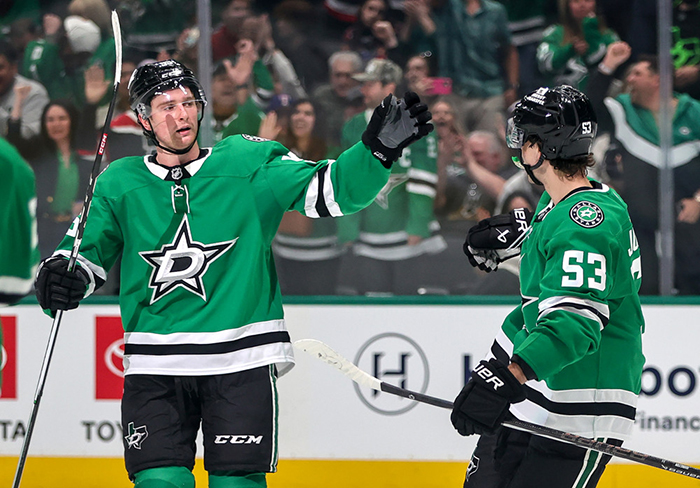
The two sets of brothers also impressed, as Brady Tkachuk scored a goal to open the game while brother Matthew added a pair of assists, and while Jack Hughes had a goal that was erased by an offside challenge, he still recorded an assist, while brother Jack added a trio of helpers.
Tage Thompson, who was left off the 4 Nations roster, added a goal, and Auston Matthews added a third-period tally.
The big question for the U.S. was who would be in net, and that question was also answered, as Connor Hellebuyck, who played the majority of minutes in last year’s 4 Nations got the start, and made a couple of good saves early but was limited in work the last two periods, finishing with 17 saves. Jeremy Swayman dressed as the backup, and either he or Jake Oettinger figure to get one of the starts with back-to-back games over the weekend, but it seems that barring a Hellebuyck meltdown over the weekend, he will get the nod once single-elimination play begins.
Next up for the United States is Denmark, which just played in their first Olympic tournament in 2022 and has never faced the U.S. in Olympic play. The Danes lost to the Germans 3-1 as the U.S. topped Latvia, so it would seem there may be a change in goal Saturday when they face Denmark, but likely return to Hellebuyck Sunday when they take on Germany, possibly with the top seed in Group C on the line.
For an American team that came into the tournament with a lot of hype, and perhaps the U.S.’s best shot at winning gold since “The Miracle on Ice” in Lake Placid in 1980, after a turbulent 20 minutes, they settled down to take control and put themselves in a good position to collect points in the three-game preliminary round and prepare for the games that matter.
And, unlike 20 years ago, the Americans also sent a message that they arrived in Italy with a medal in mind and seemingly with a collision course with their rivals down the road.