
When the Flyers signed free agent center Christian Dvorak on July 1, they probably didn’t do so with a fourth-line role in mind. It’s just a one-year deal. Nevertheless. the player’s $5.4 million cap hit suggests that general manager Daniel Briere foresees more than a fourth-line spot at even strength plus penalty killing shifts for the player.
The GM (like all general managers) will say that player roles, usage and ice time are up to the head coach to decide. That’s true in the literal sense. Over the course of the season, new head coach Rick Tocchet will make the call on where, how, and how much he’ll deploy Dvorak and every other player.
However, Briere and Tocchet clearly discussed Dvorak before July. Tocchet coached Dvorak in Arizona. The player himself pointed to his strong previous working relationship with Tocchet as one of the reasons he chose Philadelphia over competing offers. It may not have been a top-two reason, but it was one of the factors Dvorak considered.
What were the main two reasons? Dvorak himself cited that his assets — two-way center, all-situation use during his career (including PP2 as well as penalty kill time), ability to win more faceoffs than he loses, and a big frame physically — matched directly to Philly’s needs. Meanwhile, Briere cited the very same things in explaining why was willing to outbid other teams on a one-year deal.
Does that sound like a player who was brought in strictly to kill penalties and play fourth-line shifts? No, it does not.
Dvorak replaces Poehling (and Laughton) role
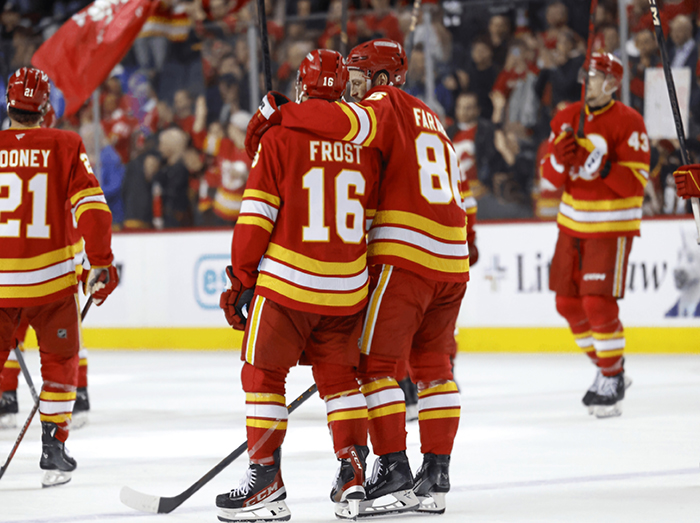
The in to take over the role that the now-departed Ryan Poehling played after the trades that sent Morgan Frost to Calgary and Scott Laughton to Toronto. Poehling moved up to a regular middle-six role (specific usage depended on the dictates of a particular game). The Flyers traded Poehling to Anaheim in the Trevor Zegras deal. With Poehling and Laughton gone, much of their former responsibilities likely fall to Dvorak.
Last season in Montreal, Dvorak put aside previous injury concerns to dress in all 82 regular season games and throughout the first round of the Stanley Cup playoffs. He averaged 15:15 of ice time. That’s not how a fourth-line player is typically deployed. That’s top-nine usage, plus special teams. Dvorak had 33 points in the regular season (12 goals) and two goals in five playoff matches. The Flyers didn’t add Dvorak with the idea of using him less than Montreal did.
Consequently, fans should expect Dvorak’s baseline to be a third-line center role (sometimes second in the rotation, but not fourth too often).
The Cates factor
Here’s where things get interesting. There are some similarities between Dvorak and Noah Cates. Cates moved back to being a full-time center as 2024-25 progressed. After the campaign, the Flyers signed the impending restricted free agent to a four-year contract extension.
I don’t think Cates will move back down to the fourth line after his uptick from November through the end of the season. I also don’t think Plan A is to move him back to left wing.
The Zegras factor
Briere has said the plan going into next season is to at least start center/winger Zegras back in the middle. The hope, of course, is to maximize the player’s offensive comfort zone. Zegras was moved to wing by former Anaheim coach Greg Cronin. Zegras worked hard at improving his all-around game (he’d always been maligned for his defensive deficiency). Cronin was pleased with the improvements. However, Zegras sacrificed a significant chuck of his offensive skill and creativity in the process.
While greatly improved in defensive execution and situational awareness, Zegras still gets out-muscled by bigger centers. He’s not an outright liability defensively anymore, but the amount of offense he lost in the trade-off is part of why Anaheim felt he was expendable. Meanwhile, he’ll never be a shutdown checker. He also struggles on faceoffs, even on his strong side. Those were the reasons why he got moved to wing in the first place.
I suspect that Briere is willing to sacrifice some of Zegras’ overall-game improvement in the hopes of aim is to get maximum offensive production from the player. That’s pretty much how Briere himself played. He tried not to be a defensive liability. Over time, he became just adequate enough in 5-on-5 responsibilities to create more goals (with power play use also factored in) than the team gave up with him on the ice. Keep in mind, though, that Briere periodically got moved from center to wing, too.
Bottom line: Zegras will start out at center. Tocchet has said as much, too. The question is whether he stays there. That can’t be answered in July.
The Couturier factor
That brings us to how Tocchet will deploy team captain Sean Couturier in 2025-26. For good reason, the player chafed when former head coach John Tortorella dropped him to the fourth line (and very briefly moved him to left wing early in the season). Couturier may not be a viable first-line center anymore like he was at the peak of his prime. He’s not what he was before two separate back surgeries that cost him a year-and-a-half of his career.
He’ll probably never approach 30 goals or 70-plus points again. Couturier will also probably never contend for another Selke Trophy (two-time finalist, one-time winner). Even so, Couturier still has enough left offensively and defensively that he’s not a fourth-liner, either.
Right now, at least, Couturier is still a better offensive player than Dvorak. Until Cates proves otherwise after posting a career-high 16 goals and 37 points last last, Couturier is still better than him offensively, too. While Dvorak and especially Cates are strong checkers, Couturier still gets the nod in terms of their total games.
How will it play out for Dvorak and company?
The likeliest scenario is that Tocchet will do a lot of experimentation in training camp and early in the regular season. Zegras may primarily play center but he may also periodically take shifts on wing. Ditto Cates for different reasons.
LIkewise, while Dvorak may start out penciled into a middle-six role, he could wind up on the fourth line rather quickly if he doesn’t play to Tocchet’s expectations. Couturier will have something to say with his play as to whether he slots above Cates and/or Dvorak. However, at least as the rough summertime plan seems to be designed, Dvorak will start out by getting around the same ice time and general usage he had under Martin St. Louis in Montreal in 2024-25.
Lastly, we can’t rule out the ever-looming threat of injuries. Dvorak stayed healthy all of last season but missed a lot of time before that. Zegras has had injury issues the last couple years. We already touched upon Couturier’s health record over the course of the 2020s. Having all four centers (or center/wingers) healthy all year would create some decisions of the “good problem” variety. Is that a bankable expection? Not right now.
In fact, that’s part of why the Flyers signed Dvorak in the first place.


Bill, great insight. What about Jett? How do you see the forwards shaking out? Forester’s injury allows a little opportunity for a young forward. I think there is still a move to be made.
Jason and I delved into some of it on Flyers Daily today. Unless Jett has a fantastic camp (better than last year’s even), I think he ends up back in Guelph until the inevitable trade — this time I do think it happens — to an OHL playoff team that’s stocking up. Luchanko is absolutely AHL ready right now (NHL still arguable) but the new rule won’t start til next season.
They may not have signed him to be the 4C, but in an ideal world he ends up there because Couts, Zegras and Cates are playing well enough to hold down the top 3 spots. Good insurance though, just in case, but if he ends up playing meaningful time in a top 6 C role it probably means the wheels have come off the bus.