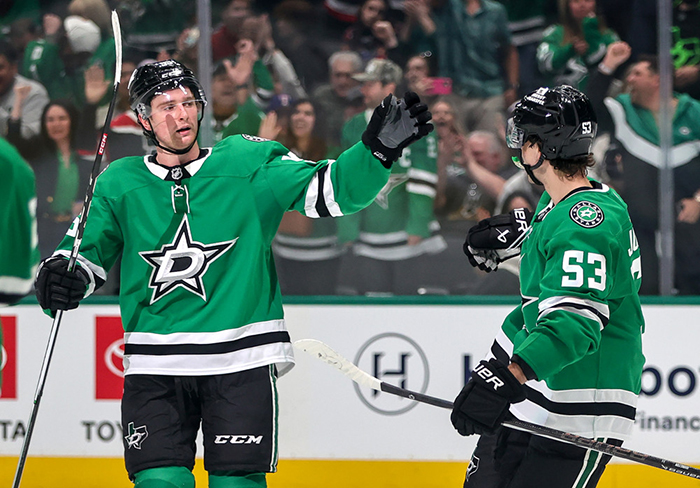
The Winter Olympics rosters were announced last week, and it provided plenty to talk about in the middle of the dog days of the hockey season. Once Canada announced their team, there were the hot takes, the questions about who was snubbed, and predictions about how far they would go (and the same thing happened when the USA, Sweden, and other rosters were announced).
The Starting Lineup:
- The polarizing views on Adam Fox
- Is Dylan Larkin an overlooked superstar in the NHL?
- Olympics: Who should replace whom?
- The veteran value in the AHL
- Quick Hits: Winter Classic, Streaks & more.
So, let’s dive into what is a player-focused version of this week’s observations. The defensemen tend to be lightning rods for praise and criticism, whether it’s Evan Bouchard or Noah Dobson. That’s become the case in recent years with Adam Fox, who was left off the USA team.
Adam Fox & Why He’s a Polarizing Defenseman
There are two camps on Fox. Either he’s a top-five defenseman and someone who should be in the Norris Trophy conversation. Or, he’s not a top-of-the-league defenseman and hasn’t been for years, making his Olympic snub understandable. Let’s look at the two sides of the Fox argument that most people gravitate towards.
The Analytics Suggest He’s Elite
There are plenty of charts that show how Fox is a great defenseman. From the basic stats to the advanced stats and the other metrics, he is one of the best in the game. Even last season, which was a rough one by his standards, Fox scored 10 goals and 51 assists and had 3.6 defensive point shares while averaging 23:15 ice time, making him a bright spot for the New York Rangers.
Fox was never an elite scorer, and it’s hard to see his value on a given shift. Like a lot of great defenseman, the plays he makes aren’t measured or stand out in a highlight video. Instead, it’s the small plays and the smart plays that stood out. Fox was always an elite puck handler, and his outlet passes stood out. It’s why he has 330 assists in 460 career games. In the recent decade, the best defense is offense, and having a defenseman who can make the pass to set up the offense goes a long way. That’s what he’s been for the Rangers to make him their number one defenseman.
That leads to the other part of his value. The Rangers are a different team with him on the ice and without him. He’s their top defenseman and treated as such, playing in all situations and making the team better across the board.
Taking it a step further, teams are better when Fox is on them. When Fox is at his best, he takes teams to the next level, and it’s not a coincidence that two of his best seasons came when the Rangers were one of the best teams in the Eastern Conference and won two playoff rounds. The Olympic team presumably would be better with him on it as well.
The Scouts See Him Differently
Like Bouchard or Dobson, there’s a large group of fans and experts alike who respond to the metrics with the simple remark “Watch the games!” And there’s a crowd that isn’t a fan of how he plays. Fox was never a great skater, and the injuries in recent years didn’t help him either. Some scouts have expressed concern over his skating, while others have also noted he doesn’t have that wow factor or make take over a game like other defensemen.
Fox often struggled to keep up with the competition, specifically in best-on-best hockey. Throw in the fact that Fox isn’t a physical defenseman who sets the tone with hits, and he’s someone who elite players can exploit. The Four Nations Faceoff put it on full display, and it’s why he was bumped down in the lineup for defensemen like Jaccob Slavin, Brock Faber, and Zach Werenski, three defensemen who could skate and play a physical game.
One scout noted that Fox has a high hockey IQ or hockeysense that masks the other parts of his game. It allows him to stand out on a game-by-game basis but he needs those other elite skills on the bigger stages, and he’s not great in those areas. Moreover, his skating has become a weakness as his metrics are below average according to NHL Edge. The Olympics are where speed and skill will stand out, and having great skaters on the blue line is paramount. It’s why Bill Guerin, who put the team together, could leave him off the roster even if head coach Mike Sullivan made a strong case for him.
Fox’s Career Arch & What it Means For The Rangers
There’s a good chance that Fox has played his best hockey. He was one of the rare players who entered the league ready to play the position, and his hockey IQ allowed him to jump right in at a young age. It helped him win the Norris Trophy in 2021 and make an immediate impact for the Rangers, who went from rebuilding to contending in a few seasons.
The thing is, he hasn’t been the same since the injuries. There are some people who are in a time warp and remember the 2020-21 season or the Rangers’ playoff run in 2022 and think that’s the version of Fox the Rangers and USA are getting. Instead, he’s a good defenseman but not in the same tier as the other great ones around the league.
At 27 years old, Fox should be entering his prime. It’s what is happening with the other defenseman who came up in his era, notably Cale Makar and Zach Werenski. Instead, his career is plateauing. This doesn’t mean that he’s playing poorly or declining. Instead, this version of Fox is what the Rangers should expect moving forward.
That’s the other part of this equation. The Rangers are in a tough spot as they might have to enter a rebuild or a reset in the offseason. The roster is older and stale, with multiple veterans on the decline. If they rebuild, it means they’ll have to trade away a handful of veterans to do so.
Ideally, Fox is a player they can build around, along with Igor Shesterkin, who is one of the best goaltenders in the game. The thing they must keep in mind is that Fox, while still a building block, isn’t the defenseman to turn things around or lead them to a Cup. He is a part of their future but they must shift their expectations around him, or they’ll remain a middling team in the future as well.
Dylan Larkin: The Overlooked Star on the Red Wings & USA Olympics Roster
Most fans will list 10 centers before Dylan Larkin, and sometimes, there’s a top-15 list that doesn’t have his name on it. He’s the type of player who flies under the radar as a good player but not a superstar who takes over games. He’s only had one point-per-game season (2024-25) and averages 28 goals per season, albeit he’s scored 30 or more in each of the past four seasons.
This season is becoming a big one for Larkin as people are starting to notice him as a top-of-the-league player. The interesting thing is that Larkin doesn’t stand out in any area and doesn’t take over games with his skill the way the elite players in the tier above him do. However, he does everything well, like a Swiss army knife of sorts. He leads the top line for the Detroit Red Wings and is a key part of their offense but he also defends well, contributing 1.6 defensive point shares in each of the past three seasons (and 1.3 halfway through this season).
Larkin also plays well in any situation. He plays fast, and it’s reflected in his bursts and distance, both of which are in the 96th or higher percentile per NHL Edge. Likewise, Larkin can also play a physical game and stand out when the game gets heavy.
Fans got a glimpse of Larkin’s great overall play at the Four Nations, as he scored the game-winning goal in the Round Robin against Canada and was one of the USA’s best forwards. Detroit Red Wings fans have seen this out of him for years, and this season it’s paying off as they are one of the best teams in the Atlantic Division and on pace to end their playoff drought.
It all leads up to this season and the year ahead that could become a career-defining one for Larkin. He will be on the USA Olympic team and asked to center one of the top-six lines. He’s the player who can make a big play or have a great game when the USA needs it the most and play a vital role in winning Gold. The games will vary, and the players who can do it all will stand out. Larkin is one of those players, and more importantly, he’s one of the centers who can match up against a top line from the other nations (Jack Eichel’s line will probably get the top assignment but he’ll get a top-six line).
Beyond the Olympics, it’s become a vital season for Larkin and the Red Wings. In some ways, he embodies their struggles in recent years as a good but not great player on a good but not great team. This season, he’s part of the core that’s leading them to a 24-15-4 record, which is the second-best in the Atlantic Division. While Moritz Seider’s emergence as an elite defenseman has played a big role while Alex DeBrincat and Lucas Raymond add a lot of offense on the wings, Larkin is the player who makes it all work and is putting together the play needed to get them over the hump.
Who Was Snubbed From The Olympics & Who Should They Replace?
It’s great content to write about the snubs from the Olympic teams and complain about the handful of players who didn’t make it. It’s a natural reaction to the lists. By the time the teams were announced, every platform and commentator had a list of snubs.
The question that’s never answered is, who are these players replacing? If a snub makes the team, who is getting taken out of the lineup? Let’s be the cynics for a weekend and take out a few players and replace them with more worthy ones.
Jason Robertson for Vincent Trocheck
Jason Robertson is the obvious miss as the skilled winger on the Dallas Stars who is putting together another remarkable season, where he’s on pace to score 48 goals. Vincent Trocheck can play center, and Guerin wants centers in the lineup. The problem is that the USA squad has more than enough centers already and is relying on Trocheck, who not only is on the decline but also coming off an uneventful showing on the international stage.
Robertson is the more skilled option and plays playoff-style hockey. He’s the forward who can net a big goal or make a big play in the offensive zone when the USA needs it most. Trocheck won’t do that, and it’s why this team might come a goal short again.
Lane Hutson For Noah Hanifin
Many point to Fox as the snub. Lane Hutson might be the bigger one, considering the upside he adds to the blue line. Sure, he’s a smaller and younger defenseman, two things that, without question, were held against him. On top of that, he’s a scoring defenseman who might be limited to the power play when the USA has options already for that role, notably Quinn Hughes, who will get most of those assignments.
That said, Hutson raises the ceiling for the USA defense. He’s taken the Montreal Canadiens defense up a notch, and they’ve been a competitive team since he joined them. Hutson takes good teams and makes them great, and the USA team can use another playmaker at the point like him, especially as a reinforcement. He should replace Noah Hanifin, who, frankly, made the team on reputation. He hasn’t done much for the Vegas Golden Knights this season and has been underwhelming for a few seasons at that but is the established name, so he made it.
Cole Caufield For Jack Hughes
This is the argument where, if there has to be one undersized forward, it might as well be Cole Caufield. Jack Hughes was a non-factor in the Four Nations and is having a rough season with the injury setting him back. The hand injury has him playing limited, and he hasn’t been the same dynamic player since returning.
Caufield, meanwhile, is a dynamic player who has 20 goals and 20 assists halfway through this season. He’s a scorer first and can net that big goal for the USA if they need it, and they’ll need it in a big game.
Evan Bouchard or Matthew Schaefer For Shea Theodore
Shea Theodore made the Canadian team because of his reputation. He’s not a great defenseman or even a reliable stay-at-home defenseman. Canada had plenty of options to fill this depth spot with, and instead chose a veteran on the decline.
This would be a great spot for Evan Bouchard or Matthew Schaefer. Yes, Canada has their scoring defenseman already, and there is skepticism about whether Schaefer is too young. That said, both should be on the team. Schaefer’s performance on Saturday night was a reminder that he can take over a game and has the skill to already dominate on the biggest stage. Bouchard is a polarizing defenseman who has struggled defensively but it’s hard to ignore his recent success in the playoffs and the chemistry he has with Connor McDavid, which can go a long way in scoring situations.
Mark Scheifele for Mark Stone
Mark Scheifele was the tough snub. He’s putting together a great season, and at this point in his career, it’s unlikely he’ll get another shot at the Olympic team. He’s the center who should have made the team but instead was bumped for Mark Stone, who also made the team on reputation, which was a theme of the selection process. The nations chose experience and physicality over skill and speed. We’ll see who it ends up costing a medal.
The Value of Veterans in the AHL
The American Hockey League (AHL) has a veteran rule. Teams must dress 13 skaters for a game who qualify for “developmental” status. Specifically, the league is built to develop prospects, and as such, most of the players in the league are either on entry-level contracts or have played a minimum number of professional games.
AHL teams are forced to have five or six veterans to choose from. They are the skaters who set the tone for the team and help develop the prospects. Finding the right mix is where having a great AHL general manager (GM) goes a long way.
Every great team in the AHL this season has a strong veteran presence. These skaters aren’t just vital for their off-ice mentorship but their impact in games as well. They teach the prospects how to play the game and what it takes to make it in the NHL.
It’s a theme throughout the league, and whenever a coach is asked about one of these players, they can’t say enough praise about them. John Gruden heaped praise on Benoit-Olivier Groulx and how “He finds ways to make linemates better.” Pascal Vincent and the Laval Rocket skaters couldn’t talk about the value Alex Belzile brings to their team. Vincent talked about Belzile being a great buffer to get the message across to the younger players, which every coach needs. “He’s a complete player with great leadership skills. He’s such a vocal, positive man. To have him it’s huge for a coach; he brings that voice to the room.”
Lane Pederson was brought in this summer as a key voice for the Lehigh Valley Phantoms but has also been asked to do it all. He’s centered the top line to help Alex Bump and Denver Barkey learned the pro game but he’s also found a way to work well with all of the turnover. The Phantoms went through a talent drain in recent weeks, with Barkey getting the call-up to the NHL but having Pederson around helped them remain a winning team and instill that winning culture head coach John Snowden is trying to establish.
Related: Pederson Standing Out With Lehigh Valley
The same bet was made by the Bridgeport Islanders, who have Chris Terry back for another season. He’s still playing on a high level and is someone Matthew Maggio can look up to. The two have spent time together on the same lines but Terry is also the player who can tell Maggio that he’s been in his shoes before and knows what it’s like to play on losing teams but knows how to power through them and still be a great player. For the younger Islander, it’s allowed him to rebound this season and look like a top prospect in the system.
The bet that the Providence Bruins made was fascinating. In a league where a lot of teams are giving up early on 24 or 25-year-old skaters, they leaned into it. Their best players are Matej Blumel, Patrick Brown, Riley Tufte, and Georgii Merkulov, four forwards who aren’t considered prospects but can fill in on the NHL level at any point and help create a winning environment. “They’re amazing for me. They know my personality really well. They’re an extension of us,” head coach Ryan Mougenel mentioned when asked about the veteran presence on the AHL team.
Dive Deeper: Providence Bruins Remain Dominant in AHL
Mougenel added that they are the players who help the prospects on a day-to-day or minor everyday things that are integral to becoming a pro. “It’s vital because it can’t always be a message from the coach on how to live away from the rink and how to be a pro. It has to come from the players who live it every day,” he added. Having Brown, Tufte, and the rest of the core players around has made the Bruins one of the best teams in the AHL this season and has set up a good pipeline. The prospects on the team are set up to succeed, which explains how Dons Locmelis has emerged as a top scoring threat with 12 goals, and when the next wave of players comes in, they’ll be in a good spot as they join a team with a winning culture in place.
The irony is that the Hershey Bears were the model for this for years. Their culture allowed prospects to take significant steps forward, and it accelerated the timeline for the Washington Capitals to contend. Now, the team is going through a rebuild, and it shows as they’ve stumbled throughout the season and aren’t the same dominant team in the AHL.
The dominant team this season has been the Grand Rapids Griffins, and one of the reasons is their veteran presence. They signed John Leonard this summer off the Charlotte Checkers roster, and the talented forward came off a deep playoff run and knew what it took to win. His play has been incredible, and his role has helped turn the Griffins into a dominant team in the process.
Other AHL Notes
The Bruins had another dominant weekend where they beat the Hartford Wolf Pack 4-1 and then defeated the Springfield Thunderbirds 3-1. Talking to Mougenel after the Friday game, it’s noticeable how this team is on a mission. He noted early in the season that the players know how close they are to the NHL, especially if the NHL team decides to pull the plug and enter a rebuild. Lately, it looks like they are on a mission to have a deep playoff run as well, something they didn’t experience last season after coming up short against the Checkers in a five-game series.
Michael DiPietro was great in both starts over the weekend and looks a lot like the elite goaltender who turned heads last season. The question Mougenel gets a lot at this point is what more does DiPietro need to do to prove he belongs in the NHL? At this point, it’s about the opportunity, and at 26 years old, he’s entering his prime years as a goaltender. The Bruins might give him that shot and allow him to back up Jeremy Swayman in the second half of this season but if they don’t, there will be teams interested in acquiring him one way or another.
It’s also worth noting that the Goaltender of the Year award will be a tight one this season. DiPietro has put himself in the conversation but Sebastian Cossa has led the way as the top goaltender for the most part and is the best goaltender on the best team (Grand Rapids). Then there’s Sergei Murashov, who is a standout in his rookie season and proving that it’s only a matter of time before he’s given an NHL opportunity.
The Toronto Marlies had a five-game winning streak that featured a thrilling 6-4 win over the Rochester Americans. It catapulted them into third place in the North Division, and their success is a credit to the job that Gruden has done as he’s kept this great despite a suspect prospect pool and questionable goaltending (at some points this season, they were on their fourth-string options because of injuries). The Marlies ended their streak on Sunday with a 6-1 loss to the Phantoms, who are starting a run in their own right. With five wins in their last six games, the Phantoms have jumped into third place in the Atlantic Division.
I was in Bridgeport for the Saturday night game against the Wolf Pack. I watched the game alongside Kenny Kaminsky from Isles in the Sound, which was a great experience since it wasn’t long ago that the Total Mortgage Arena press box was an empty and lonely place. With him and Keegan Jarvis, who covers the Wolf Pack for Blueshirt Banter, in the box, it was a full house, and all three of us could bounce ideas about the teams and hockey off of each other. It shows how AHL coverage has come a long way in a few short years but also how many young writers there are out there who like the players, are eager for that call-up (which hopefully happens someday).
The game led to a few Bridgeport Islanders thoughts (or one big one). They love to play in track meet games, and there are plenty of scoring chances for both teams. It’s not ideal for winning games but it’s fun to watch. Plus, it’s a good way to develop forwards as they put in a lot of favorable situations offensively. Maggio has taken a big step in this system, and Alex Jefferies is having a rebound season as well. For a team that was going nowhere and provided minimal positives a season ago, it’s a step in the right direction.
Quick Hits: Winter Classic, Streaks & More
The Winter Classic happened this week. It’s hard to stay optimistic about it, and this was one of the more uneventful ones in recent memory. The game itself was a 5-1 win for the Rangers against a Florida Panthers team that still looks like it’s playing at a lower gear than the rest of the league. Maybe that changes when Matthew Tkachuk returns but for now, they are still playing like a borderline playoff team.
The NHL is looking to expand into Florida, and the outdoor games are part of the allure. The game at LoanDepot Park, where they have a retractable roof, didn’t have the same appeal. The NHL should host more games in Florida but if there’s nothing Classic about the game, at least there should be some Winter aspect to it.
The next game is in Tampa Bay in February. The hope is that the weather holds up, so this means Casey Stangel’s quote might be relevant: “There are three things that can happen: you can win, you can lose, or it can rain.”
- The Buffalo Sabres had their 10-game losing streak snapped on Saturday. Now, everyone is wondering whether the streak is a one-off or if the Sabres have indeed turned a corner on the season and are ready to snap the longest playoff drought in the NHL.
- The team with the longest winning streak in the NHL now are the Tampa Bay Lightning, who, with seven wins in a row, have the best record in the Atlantic Division. It’s a hard team to figure out but their ability to remain a top team is a credit to Jon Cooper, who doesn’t get enough of it as a great coach.
- The Pacific Division doesn’t have a team pulling away from the pack. The Anaheim Ducks, Edmonton Oilers, and Vegas Golden Knights have all struggled lately, and none of them looks like Cup contenders. The Colorado Avalanche have a 23-point cushion on the Golden Knights and Oilers, who have the best record in the Pacific, while the Dallas Stars and Minnesota Wild have a 12-point cushion on both teams.
- The Pittsburgh Penguins and the Seattle Kraken looked like early sellers to watch a week back. Now, with the Penguins on a five-game winning streak and the Kraken winning six of their last seven games, both teams are back in playoff positions.
- The Winnipeg Jets, meanwhile, last won a game on Dec. 13 and have the worst record in the NHL. The historians love to point out how they were the Presidents’ Trophy winners last season and now are on track to have the worst record in the league. The bigger picture problems stand out since the Jets aren’t in a good spot to rebuild and are the opposite of a destination, limiting their options if this ends up being a lost season.