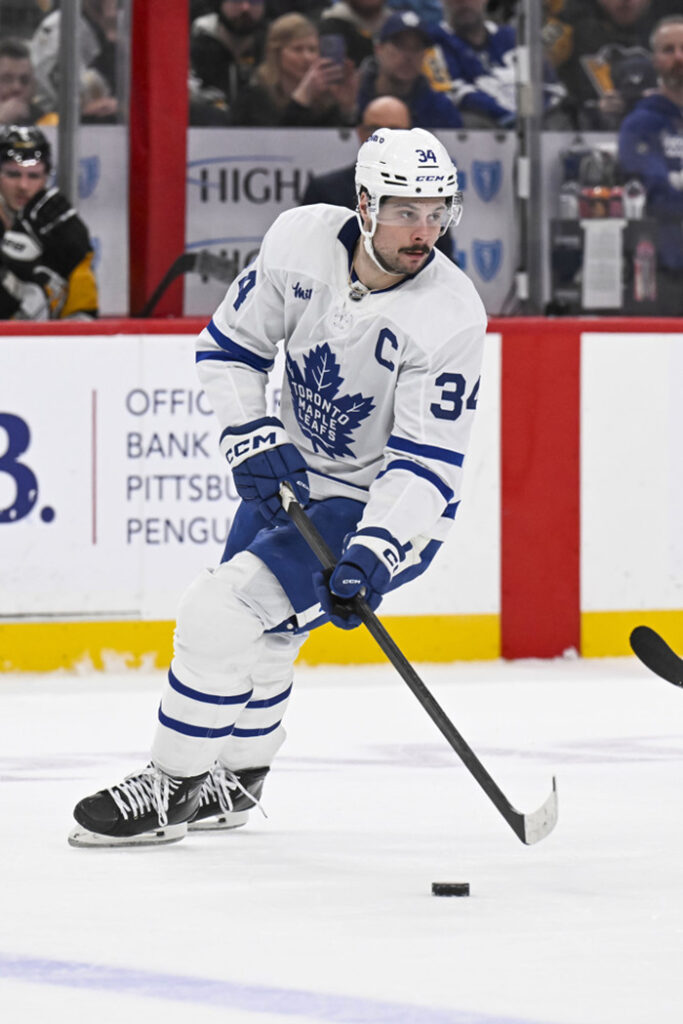
The Toronto Maple Leafs once again found a way to lose on the road, which has been a complete reversal of fortune from last season when they had the second-best record in the league at 25-13-3 to this season, where so far they are 5-10-2. The Leafs put together a good effort against the NY Islanders, led by team captain Auston Matthews’ two goals that broke Mats Sundin’s team record of 420 goals, but leading 3-2 in the third period, the Isles took advantage of Toronto defensive breakdowns to tie the game late in regulation and win it in overtime on Matthew Schaefer’s second of the game.
The Leafs did get a point in the loss and are 4-0-2 in their last six games, but that is a pyrrhic victory and cannot be accepted where they are in the tight Eastern Conference race, especially against an opponent that they could be battling with for a playoff spot. The scapegoat for the loss was defenseman Morgan Rielly, who was -4 on the night, was walked around on Schaefer’s first goal and was caught overplaying Matt Barzal going behind the net and allowed Schaefer a free and clear chance in front of Joseph Woll for the game-winner.
Rielly has been the focal point for criticism for most of the last two years, especially after a subpar first offensive year under Craig Berube and a poor playoff performance against Florida. What has been ignored is that Rielly played much better once Brandon Carlo was acquired from Boston at the trade deadline, and this season is on pace to exceed 50 points. The issue with Rielly has always been playing in his own zone; he is an average defender at best, but his positives have been his ability to advance the puck and his vision and playmaking ability in the offensive zone.
The 31-year-old is slowing down, but he still can be an offensive driver, and is essential to the Leafs blueline with only Oliver Ekman-Larsson as a viable scoring producer on the back end. Rielly was forced into extra usage late in the third with Jake McCabe going down with a lower-body injury. The absence forced Berube to shuffle his defensive combos and on Emil Heineman’s tying goal, Rielly was paired with Simon Benoit.
It has been clear for years that Rielly is not a legitimate #1 defenseman in the NHL; he is likely an adequate #2, or at this point of his career, a good second-pairing defenseman. Gone are the days when you could pair him with an aging Ron Hainsey or TJ Brodie and get away with it. Rielly has played his best hockey when he was partnered with Carlo earlier in the year, or when Berube put all his eggs in one basket and played him with OEL. When has he played his worst? When he has to overcompensate for a weak partner like Philippe Myers, or more accurately, a partner who can compensate for his defensive inefficiencies.
This is similar to Dion Phaneuf in the last decade, when Ron Wilson or Randy Carlyle paired him with such luminaries as Mike Kostka, Korbinian Holzer, or Jake Gardiner. Rielly is not the problem; the overall lack of depth created by injuries has been the issue. The Leafs cannot load 27 minutes on Morgan Rielly any longer. Maybe when Carlo returns in the next week or so, some of Rielly’s issues will become less glaring.
The potential loss of McCabe could be catastrophic for Toronto, as the blueliner did not return after an apparent lower-body injury. Berube said that an update would be forthcoming on Monday. There was some potentially bad news regarding the status of Chris Tanev.
The Fourth Period’s David Pagnotta reported on Sunday that the Leafs shutdown defender will be meeting with doctors this week to see if he needs surgery for a reported groin injury. If surgery is necessary, it could keep Tanev out the rest of the regular season and into the playoffs. The loss is one thing, but the changes to the LTIR rules this season give the Leafs only a percentage of Tanev’s salary as cap relief. The only way they would have the full $4.5 million in cap space is if he is ruled out for the entire season, including playoffs.
That is the same situation as winger Dakota Joshua, who suffered a kidney injury in Detroit late last month. The Leafs need the cap space to be able to acquire players, but they also are light on assets to trade for potential replacements. If McCabe’s injury is long-term, Toronto’s defense will be without its shutdown pairing for a significant chunk of the second-half of the season, and that could be something they cannot recover from.