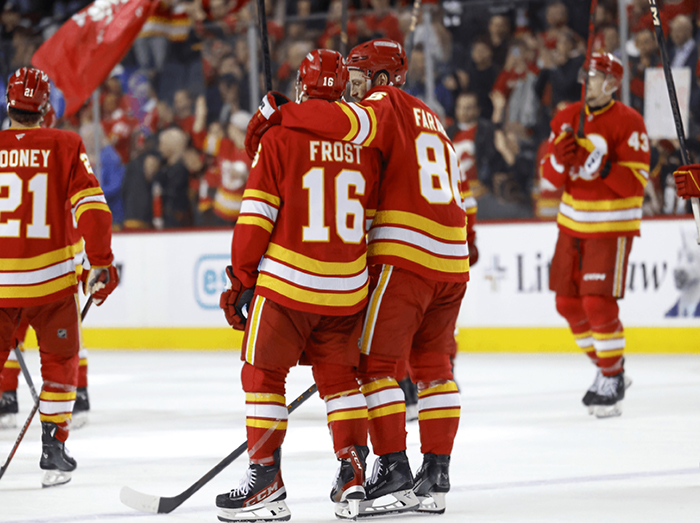
Surpassing the quarter mark following Sunday’s 6-1 loss to the Anaheim Ducks, the Calgary Flames have posted some surprising results.
Their record? Not exactly. 9-11-1, good for 24th place, isn’t raising too many eyebrows in the 403. The Flames love hanging around .500 even in a rebuild season.
Individual results? Devin Cooley’s immaculate start aside, is anyone surprised that there arent any Flames producing above 0.81 points per game?
We’ll spare you the guessing game. The Flames have gone from arguably the slowest team in the NHL last season to an above average group in terms of speed metrics. While it’s tough to compare totals given that we’re comparing 21 games to 82, it’s important to note where they rank compared to the rest of the NHL.
Last Season vs. This Season: Speed Metrics
18-20mph Speed Bursts
2025-26: 7303 (30th)
2026-27: 2136 (9th)
20-22mph Speed Bursts
2025-26: 1151 (32nd)
2026-27: 441 (17th)
+22mph Speed Bursts
2025-26: 28 (32nd)
2026-27: 23 (13th)
A complete turnaround in year one of a rebuild.
While it’s not exactly perfect form when it comes to hunting a top-3 pick at the 2027 NHL Entry Draft, it’s worth digging into. The Flames are no longer even close to the slowest team in the NHL. Here are five contributing factors to Calgary’s uptick in velocity.
1. New Approach
Head Coach Ryan Huska pointed it out several times last season and rightly so. Calgary was a downright slow team for the majority of the 2025-26 regular season.
Huska spoke on the team’s speed situation at the end of last season during an interview with Pat Steinberg the now-shuttered Fan 960. Link unavailable due to the digital resource being pulled.
“There is analytics on everything nowadays and our team is, analytically, slow,” pined Huska.” So, that’s a little bit about the footspeed on our players and the way we play. All of those things come into the equation for this.”
“We tried to get them to think it a little bit quicker and really if we’re going to make up for a footspeed issue, you have to think and play the game faster, so we tried to get them, number one example of it is, leaving our own zone. If we got possession right away or if we knew we had complete control, we asked our forwards to blow the zone. So, we think you saw a lot more of that the second half of the year. And I think we ended up with the sixth-most odd man rush chances from that portion of the year on. So, we were generating speed through the neutral zone more so because of the mentality and thinking the game differently.”
Long quote, but this is the heart of Calgary’s speed issue. Yes, they were slow, but they also played a slow game with the puck. Huska continued.
“Another example of that is asking them to be much quicker when we created a turnover. So, whether that turnover was in the neutral zone. Whether it was in the offensive zone, we wanted them to get it to the net right away.
“So, changing a thought mentality allowed us to be a little quicker in those areas and that allowed us to generate a little bit more. The areas that we have to work on now are even-man rush situations when it’s one-on-one type stuff, and in the offensive zone.”
There is a lot to unpack there, but it’s undeniable that the shift began from the top; Ryan Huska and his coaching crew pushed for a change and now we’re looking at defined results.
The adjustment of approach is undeniably the number one factor. Credit to the coaching staff. There was also some personnel changes that factored in greatly.
2. New Outlet Passers
The Calgary Flames began last season with two go-to offensive defencemen.
That being Rasmus Andersson and MacKenzie Weegar. For those who spent last year living off the grid, Andersson was traded to the Golden Knights on Jan. 18 and Weegar was traded to the Utah Mammoth on Mar. 4.
Two words united those two defencemen: breakout habits.
Those who watched Flames games throughout the entirety of both of those player’s time with the team can recount innumerable instances of Rasmus or MacKenzie waiting, and waiting, and waiting until the play is beyond dead to make an outlet pass.
The forwards skate their routes and have to start another route to keep moving, the other team sets up on the blue line; easy turnover and the opposition takes possesion.
Whether it was stubbornness, a lack of coaching emphasis, or something else: that habit absolutely destroyed the Flames ability to take the offensive blue line with speed. This season, we’ve seen much quicker pucks up the ice thanks to Zayne Parekh and Simon Nemec occupying those roles.
Speed Metrics: Calgary’s New Outlet Passers
Zayne Parekh
18-20mph: 129 (55)
20-22mph: 23 (9.4)
+20mph: 0 (0.4)
Simon Nemec
18-20mph: 95 (55)
20-22mph: 15 (9.4)
+20mph: 1 (0.4)
Nemec sits comfortably around the 80th percentile in all categories. Parekh, meanwhile, sits at the 94th percentile at 20-22mph bursts and the 97th at 18-20mph bursts. To Weegar and Andersson’s credit, their speed metrics were fine last season. It was more about quickness of outlet passing—which publicly available NHL stats are simply not close to disclosing.
All we can do give the pudding the eye test and assume the proof is hiding on a number of paywalled servers. Looking at you, SportsLogiq.
If we’re talking about veterans with bad habits, Andersson and Weegar are far from the only guilty party.
3. Minute Muncher
Calgary’s leading scorer for the two years prior and holding the team lead at the time of his trade to the Colorado Avalanche, you would expect Nazem Kadri to be a speed demon.
The harsh truth was that, while he loved to carry the puck, Nazem only consistently reached the 70th percentile in speed bursts in the lowest category: 18-20mph speed bursts.
2025-26 Speed Metrics: Nazem Kadri (vs. league average)
18-20mph: 415 (313)
20-22mph: 43 (71.4)
+20mph: 1 (3.8)
Mind you, this was a forward that led all Flames forwards in average time on ice by a vast margin.
TIO Per Game Leaders: 2025-26 Calgary Flames Forwards
Nazem Kadri: 19:22
Jonathan Huberdeau: 18:08
Mikael Backlund: 17:57
It’s not nice to drag a player. Kadri has a fantastic work ethic and scored so many highlight reel goals. He almost carried the 2024-25 Flames to the playoffs with 12 goals in the final 16 games of the season.
Did he have a ton of bad habits though? Absolutely.
Kadri was never a burner and loved to carry the puck through the neutral zone. He was a shameless volume shooter with a low percentage shot. He received prime offensive deployment regardless of how well other forwards were playing. Those three factors did not help make Flames a faster team on the ice.
This all is more about Kadri. He is a great player, but not a burner. He does best work in established chaos. Nazem has 17 points in 21 games this season. All five of his goals this season are from the low slot. Meanwhile, his speed metrics are, well..
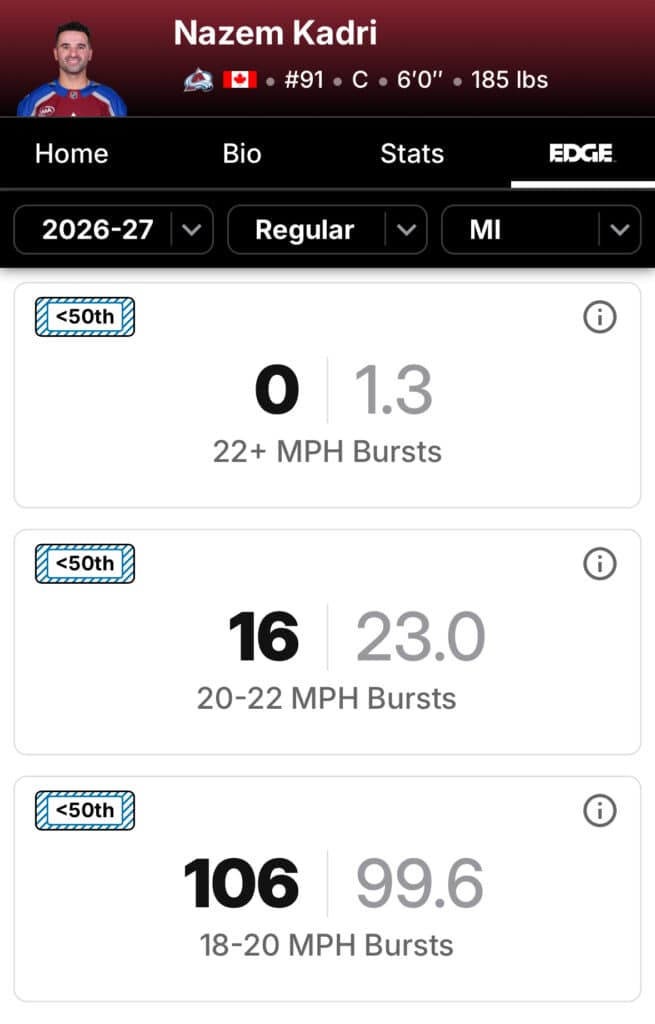
Bad.
You may have noticed another forward in the stats above.
4. The Bad Hip
It’s no secret that Jonathan Huberdeau was playing hurt last season. The Saint-Jérôme, Quebec product tapped-out at the 50-game mark in order to get a hip resurfacing procedure. His return looms and hopefully he excels.
The question is, why was a player with a busted hip playing the second-most minutes on average among Flames forwards?
We don’t know how long his hips had been bothering him, but his speed metrics haven’t been above the 60th percentile in any category since being acquired by the Flames on July 22, 2022. In most cases his annual speed metric totals have been less than half than league average.
Listen. It had to be said. This is why you’re visiting the Hot Stove. If we don’t say it, no one will.
It’s important to note that this hasn’t all been coaching and addition by subtraction.
5. Metrics Beast
Matvei Gridin has been an absolute handful in the neutral zone this season.
Only four points shy of the team lead in points with 13 in 21 games, the 20-year-old left winger is only scratching the surface. It’s worth noting that his metrics show that there is consistency to the highlight plays.
2026-27 Speed Metrics: Matvei Gridin (vs. league average by position)
18-20mph: 133 (99.6)
20-22mph: 52 (23)
+20mph: 6 (1.3)
Gridin sits in the 92nd percentile in 20-22mph bursts, the 94th in +20mph and the 68th in 18-20mph. His six highest speed bursts account for over a quarter (26.09%) of Calgary’s total of 23.
One last factor.
Bonus: Return of the F1
Last season was a write-off for the ever-scrappy Martin Pospisil.
A concussion sustained at the hands of a Derek Forbort preseason uppercut saw the Slovak Olympian miss 60 games. His metrics dropped to well below his career averages. It was a rough year.
The season prior, Pospisil sat in the mid 90th percentiles in 20-22 and +22mph speed bursts. Huska had taken to deploying him on the first line so he could generate turnovers for Nazem Kadri and Jonathan Huberdeau. Their 291:30 together at 5v5 ranked behind only the unit of Coronato, Backlund, and Coleman in time on ice.
The Flames simply missed Martin Pospisil last season.
Healthy again, Pospisil is once again tearing up the ice.
2026-27 Speed Metrics: Martin Pospisil (vs. league average by position)
18-20mph: 135 (99.6)
20-22mph: 51 (23)
+20mph: 4 (1.3)
It doesn’t hurt that Martin now plays on a line with Matvei Gridin. Being deployed with another burner had been a rare luxury for Pospisil to that point. Pospisil’s 4 +20mph bursts is 90th percentile and his 51 20-22mph bursts is 92nd percentile. Combine that with his 100 hits (second in the NHL) and we’re starting to see Martin Pospisil the six-foot-two agitator playing his true style again.
Statistics courtesy of MoneyPuck, Capwages, and the National Hockey League.
Keep Reading:
Flames: Can Regression Be Avoided?
Kevin Bahl Out for the Season: 5 Things to Consider
The Rise and Fall of Connor Zary
Follow on X: @Trevor_Neufeld