The Chicago Blackhawks latest roster shuffle tells a familiar story: development decisions up front, experimentation behind the bench, and a team still searching for offensive answers. Nick Lardis heading back to Rockford is part of that process — but it’s far from the root of Chicago’s scoring issues.
Lardis: Development Over Desperation
Sending Nick Lardis to the AHL isn’t an indictment of his NHL stint. In fact, it’s the opposite. The rookie showed poise, finishing ability, and flashes of confidence in limited minutes. But inconsistent usage and a constantly shifting forward group made it difficult for him to settle into a true scoring role.
Rockford offers Lardis something Chicago can’t right now: heavy minutes, offensive responsibility, and a chance to grow without being caught in the lineup blender. The mistake would be yo-yoing him again. The next recall needs to be permanent.
Blashill’s Line Shuffling: Searching for Chemistry
Jeff Blashill resisted the urge to shuffle his forward lines for much of the season, valuing continuity and predictability for a young roster. But with Chicago stuck in a prolonged scoring drought, that patience finally ran out. The return of Teuvo Teravainen from injury, combined with a fully healthy forward group, forced difficult decisions — including sending Nick Lardis back to Rockford and reworking key combinations up front.
The most notable adjustment came at the top of the lineup, where Connor Bedard was moved alongside Teravainen and Frank Nazar. The idea is clear: Teravainen provides puck support, structure, and experience, while Nazar brings pace and creativity — allowing Bedard to focus on attacking space rather than carrying the entire offensive burden. It also marks the first extended look at Bedard and Nazar together, a pairing the organization has long viewed as a potential driver of future offense.
Elsewhere, Andre Burakovsky slid down to the third line, skating with Oliver Moore — shifted back to his natural center position — and Ryan Greene. The move reflects both Burakovsky’s recent struggles and Blashill’s desire to simplify his game, while giving Moore more responsibility down the middle where his speed and defensive awareness can be better utilized.
While the line changes are targeted rather than wholesale, they underscore a larger truth: the issue isn’t just chemistry, it’s execution. Chicago has generated chances, but finishing — especially in advantage situations — remains a glaring problem. Until that changes, even the right combinations may only move the needle so far.
Bedard’s Load Keeps Growing
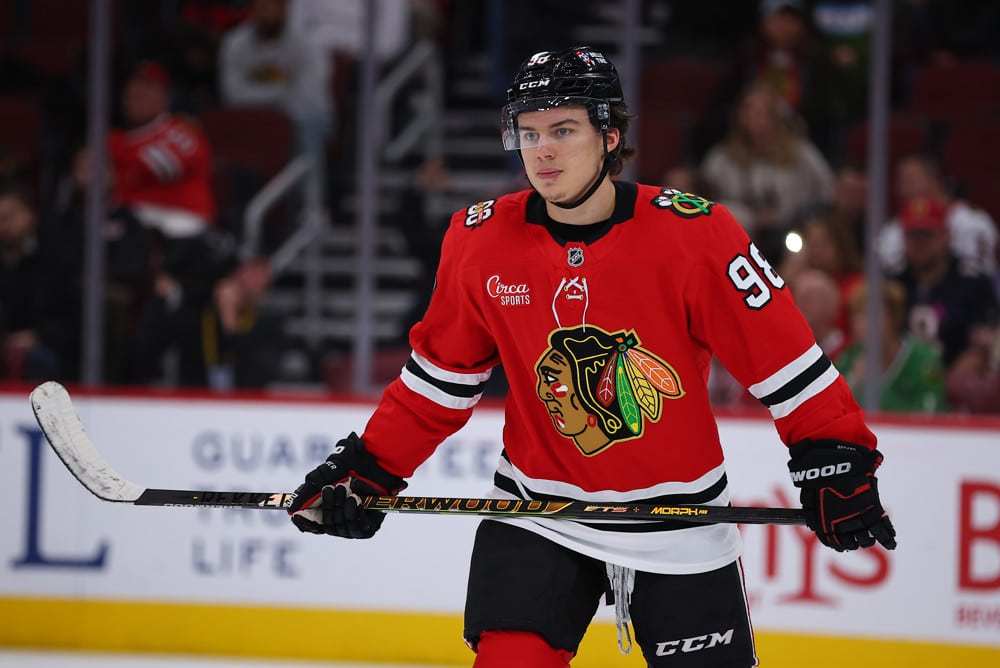
Connor Bedard remains the engine of this offense, even when the production doesn’t show up on the scoresheet. Since returning from injury, he’s been tasked with driving play, adapting to new linemates, and carrying the power play — all at once.
The concern isn’t Bedard’s talent. It’s usage. When the power play stalls, five-on-five pressure increases, and every missed opportunity magnifies the frustration. That’s where the system — not the superstar — needs scrutiny.
The Power Play: Where Everything Breaks Down
No area better summarizes the Blackhawks’ struggles than the power play.
PP Units
- PP1: Bertuzzi — Bedard — Teravainen — Moore — Levshunov
- PP2: Foligno — Burakovsky — Donato — Nazar — Grzelcyk
The results? Brutal.
Chicago is 0-for-17 over its last seven games. In 32:37 of power-play time, per NatStatTrick, the Hawks generated:
- 29 shot attempts
- 14 shots on goal
- 21 scoring chances
- 8 high-danger chances — while allowing 5 against
- 2.15 expected goals
- 1 shorthanded goal against
The volume is there. The execution is not.
Too much perimeter play. Too little movement after the first pass. Entries that die at the blue line. And when breakdowns happen, they happen fast — turning man-advantages into momentum killers.
This isn’t about talent. Bedard, Teravainen, Nazar, and Moore should be driving a dangerous unit. Instead, the power play has become predictable and passive.
The Bottom Line
Lardis going down won’t fix this. Line shuffling alone won’t fix this. And asking Bedard to shoulder everything won’t fix this.
Until the Blackhawks simplify their power-play approach, increase urgency, and protect against shorthanded chances, the offense will continue to stall — no matter who’s on the ice.
Development is important. Chemistry matters.
But right now, the power play is holding everything back.
Next Game
Tonight at Minnesota 7:00PM CDT