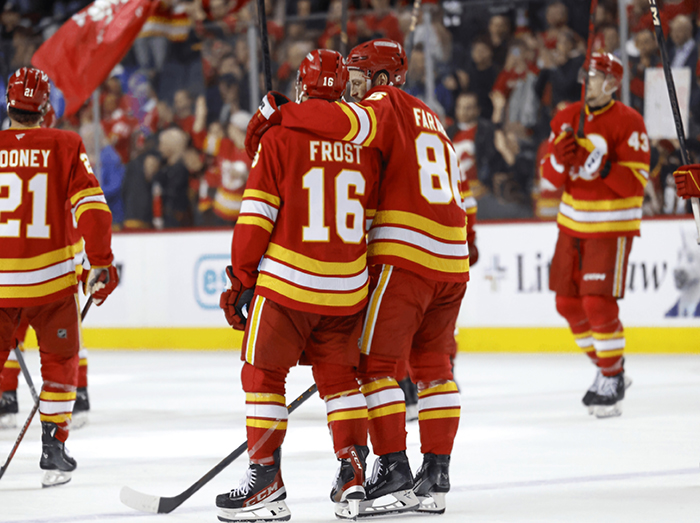
With the Olympic break looming and one more chapter of the 2025-26 Battle of Alberta to play out, Calgary Flames forward Jonathan Huberdeau elected to stick it out.
Despite struggling with hip issues that had been deemed to require season-ending surgery, the 32-year-old star left winger took one final ride for the year. Lo-and-behold, Huberdeau opened the scoring with a beautiful shot from the right circle.
With a borrowed stick from 20-year-old rookie phenom Matvei Gridin no less.
The Flames went on to take the game 4-3 and the season series against the Oilers 3-1-0. Their only representation at the 2026 Winter Olympic Games being Slovakia’s Martin Pospisil, the rest of the team got some well-earned time off.
For Huberdeau, that was lights on the season. The St. Jerome, Quebec product will undergo hip resurfacing in March with the goal of returning to play in September 2026. Much like his former linemate Anthony Mantha, he’ll be sticking around the team and stay in proximity of medical professionals in order to help with recovery, but that is as far as it goes. A tedious amount of physio is undoubtedly part of his immediate future following his procedure.
“After extensive evaluation, this was determined to be the best course of action for Jonathan’s long-term health and performance,” said Flames General Manager Craig Conroy in a media availability on Feb. 5.
“While it is difficult to lose a player of his calibre, our priority is ensuring he is fully healthy moving forward. Huberdeau has been managing hip-related symptoms throughout the season. The decision to proceed with surgery was made in collaboration with Jonathan, his representative, our medical staff, and specialists to support his long-term well being.”
We are now left with two uncertainties:
1.) How long have these hip issues been a problem?
This goes for every team in the NHL, but it’s simply impossible to decipher the real truth when it comes to teams self-reporting injuries.
Players may disclose the full extent of what they were playing through, but long term or current stuff rarely finds its way to the public. There is rarely any benefit to releasing that information and players don’t like having that information out there.
When it comes to Huberdeau, it may explain a lot if he had been struggling with hip problems going back to his first season on the Flames in 2022-23. Very rarely does a player does a player experience such a precipitous drop in production, 115 points on the Florida Panthers the year before to 55 in his first year in Calgary, without some form of physical issue hindering their play.
2.) What was keeping Huberdeau deployment so high if he was struggling so greatly?
Huberdeau’s season is done and the six-foot-one playmaker has ten goals and 15 assists to show for it. 25 points. Had he played out the final 26 games at that pace, he would have finished with 15 goals and 23 assists for 38 points; an eight-year low in terms of total and an 11-year low in terms of points per game. Despite his low production, Huberdeau averaged the second-highest time on ice per game among forwards at 18:08 behind only Nazem Kadri at 19:27.
Huberdeau has seven power play points on the season in 145:40 of time on the man advantage. There is a near 50 minute disparity between his fourth-place deployment and the player below him, Yegor Sharangovich at 95:48 of power play time.
Lots of deployment, not a lot of results.
Huberdeau ranks eighth among all forwards in average power play production at a rate of 2.88 points per 60. For those interested, the two team leaders in power play points per 60 are Matvei Gridin (8.07) and Connor Zary (4.59).
Gridin averages 1:43 of power play per game. Zary averages 1:42. An injured Jonathan Huberdeau averaged 2:55.
A player on pace for under 40 points while getting prime offensive deployment should be questioned.
Should. The Calgary Flames fanbase (and the media that covers them) are long past the saturation point when it comes to asking questions about Jonathan Huberdeau’s deployment. It wouldn’t be unfair to question whether the former Calder Trophy winner had some informal assurances included when he put pen to paper on an 8-year $84,000,000 deal in the summer of 2022.
The hard truth is that if those assurances don’t exist, there is a far greater problem on the Flames when it comes to coaching.
Points per 60 minutes of ice time since Oct. 2023 – 5v5*
Tyler Toffoli: 2.41
Nazem Kadri: 1.94
Elias Lindholm: 1.87
Dillon Dube: 1.83
Andrew Mangiapane: 1.82
Blake Coleman: 1.72
Jonathan Huberdeau: 1.66
Walker Duehr: 1.59
*Minimum 82 games played
Those rates only look worse when you factor in that Huberdeau is getting the preferential offensive zone deployment. Since his first game in Oct. 2022, Huberdeau leads the team in even strength starts in the offensive zone. Him and Nazem Kadri are are at the top of the list with a drastic falloff at #3 Blake Coleman.
Even Strength Offensive Zone Faceoffs – Since Oct. 13, 2022
Jonathan Huberdeau: 1429 (61.38%)
Nazem Kadri: 1415 (61.60%)
Blake Coleman: 1043 (45.25%)
Mikael Backlund: 1022 (43.18%)
You would think that major hip issues would affect that rate, but there isn’t much difference in terms of allocation this season. Huberdeau has gotten a higher percentage of his faceoffs in the offensive zone this year compared to previous seasons.
5v5 Offensive Zone Faceoffs
Nazem Kadri: 368 (66.91%)
Jonathan Huberdeau: 324 (67.94%)
Joel Farabee: 285 (63.19%)
The deeper you go, the worse it looks. There are some brutal stats that underlie some chemistry problems. Tenth place among forwards in secondary assists per 60 (min. 82 GP) since joining the Flames may indicate that he doesn’t have the right ingredients on his line to make extended plays leading to goals.
The point of this column isn’t to dunk on Jonathan. He’s doing his best and keeping his head up despite his offensive struggles.
This is all to point out that there is a hockey-related problem on the Flames that could strike at the heart of a rebuilding culture that the team has been trying to establish for the past two and a half seasons.
Earning Your Opportunities
Jonathan Huberdeau checks so many boxes when it comes to being a respected veteran in the National Hockey League.
He’s beloved by teammates.
Like the rest of his team an active member of the community and does everything he can to make Calgary a better place to live. The lives he’s impacted by being part of community involvement initiatives is immeasurable. He’s a good man and he puts his heart into his work on and off the ice.
When he does hit the highlight reel? He is celebrated by any and all within the Flames community.
But his top-of-the list deployment through so many struggles underlines the fact that the Flames aren’t maintaining an absolute meritocracy. This is not speculation. Any deviation from that ideal foments resentment within a lineup of players that all believe that they should be getting choice opportunities if they earn it.
There is no better of an example than Matthew Tkachuk. The sixth overall election at the 2016 NHL Entry Draft informed Flames management during the 2022 offseason that he wouldn’t be signing an extension when his contract expired on July 1, 2023. In an attempt to keep the competitive window open, Tkachuk was traded with a conditional 2025 fourth round pick for a package of Huberdeau, defenceman MacKenzie Weegar, a conditional 2025 first round pick, and center prospect Cole Schwindt.
As time has passed, we’ve gotten glimpses into what wasn’t an ideal situation for the player. Tkachuk revealed on the Spittin Chiclets podcast on Nov. 8, 2022 after he had been dealt to the Panthers that he wasn’t entirely happy with former head coach Darryl Sutter’s level of trust in him when games got to 3v3 overtime.
The interaction centered around arguably the greatest highlight reel goal that the Flames have scored in the last decade.
Paul Bissonette: “Is that when you did the trick shot between your legs?
Mike Grinell: “Yeah, look at it, Biz, it’s on Google. It’s sick.”
Matthew Tkachuk: “I got lucky. Very lucky.”
PB: “What a modest guy. You’re not practicing that?”
MT: “No, I’m not practicing, but I probably should. I tried it last night and hit Reimer right in the stomach, so maybe I should get practicing more.”
PB: “I could imagine you getting back to the bench if you wouldn’t have scored that and Darryl just losing his [expletive] mind.”
MT: “No, he wasn’t there yet. No, I was playing OT then. So yeah, that was before his time.”
Tkachuk ranked fourth in overtime deployment in 2021-22 with 9:12 of ice time. Behind Johnny Gaudreau (22:54), Elias Lindholm (22:35), and Mikael Backlund (13:09).
Year-by-Year Average TOI per Overtime: Matthew Tkachuk
2016-17: 0:00
2017-18: 0:44
2018-19: 0:31
2019-20: 1:17
2020-21: 0:53
2021-22: 0:32
If the Flames organization has learned anything from the Matthew Tkachuk situation, it’s that talent only puts up with artificial obstacles for so long. Tkachuk and the Florida Panthers have gone on to three Stanley Cup Finals appearances and have won two Stanley Cups in three years since acquiring the power winger. Last playoffs, Tkachuk scored the Cup winner against the Edmonton Oilers in Game Six. Former Flame Sam Bennett, who at one point requested a trade out of Calgary before rescinding, was awarded the Conn Smythe Trophy for most valuable player on his team during the 2025 Stanley Cup playoffs.
The same Sam Bennett that found himself mired in the bottom six for so many years with linemates such as Mark Jankowski, Milan Lucic, and Derek Ryan. Often out of his natural position at center. When he finally got an extended look in the first line with Johnny Gaudreau and Sean Monahan in his final season with the Flames, it was still out of his natural position.
Monahan, known for playing through anything and everything, held priority at center over Bennett. No matter how banged up he was on any given night.
You can decide for yourself whether that organizational approach benefited either player in the long run.
Looking Forward
There are two possible outcomes for Jonathan Huberdeau next season. Either he comes back finally feeling better and we see a resurgence, or we see him continue down the same path that he’s been on for the past three and a half seasons. If it’s the latter, fans and media alike will be forced to ask, at what point do we see quality deployment start aligning with offensive production?
With Huberdeau only in year three of his eight-year contract, this all leads to one final question:
Can the Calgary Flames, as an organization, learn and adapt their development strategy in the wake of their greatest asset management fumble in the last 30 years?
Statistics courtesy of Cap Wages, Natural Stat Trick, and the National Hockey League.
Keep Reading:
5 Post-Olympic Questions Surrounding the Calgary Flames
Jonathan Huberdeau Gets Surgery – Zary’s Rebound – Gridin
6 Flames On-Ice Trends Following the Rasmus Andersson Trade
6 Quiet Truths Behind the Rasmus Andersson Trade to Vegas
Follow on X: @Trevor_Neufeld
Looking for discussion? Check out our forums section and weigh in on what’s happening around the NHL!