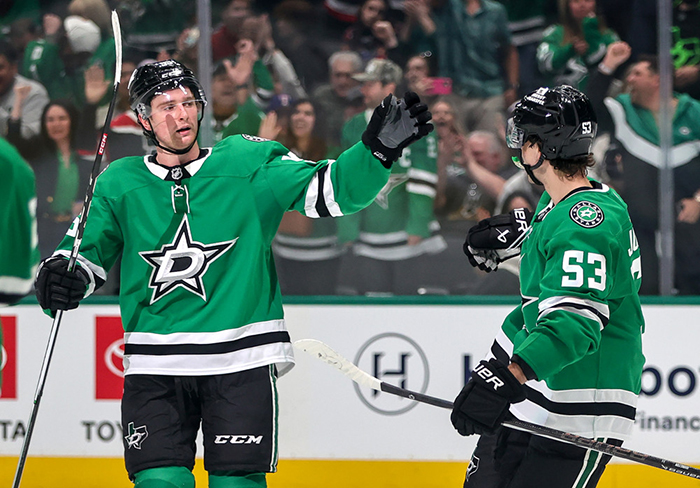
The United States finished its preliminary round with a perfect 3-0 mark, outscoring opponents 16-4, all despite an uneven effort that saw it even in goals for the first period after slow starts, but finished with a +12 in the final 40 as it wore teams down as the game progressed.
But come Wednesday, none of the preliminary-round matters.
While the U.S. finished atop Group C, they still likely will face one of the gold-medal contenders in Sweden on Wednesday in a win-or-go-home contest where neither the Americans’ unbeaten record nor the Swedes’ struggles will matter.
In fact, either the U.S. gets the Swedes coming off a tune-up win over Latvia on Tuesday, or an upset-minded rematch with Latvia off an upset win over Sweden.
And, after a preliminary round that sometimes resembled a tune-up for the real thing, the jump in play the Americans will face will be noticeable coming after perhaps the softest three games so far in the tournament.
Single-game eliminations in Olympic play can be cruel, and if the United States turns in another slow start on Wednesday, this time it could spell the end of their medal hopes. Perhaps the Americans will adjust their play level to the competition and situation, as while the U.S. has been dominant at times, at others, they have looked rather ordinary.
But there are signs the U.S. may be able to put together another three wins to bring the Americans their first gold medal since 1980, as the starting goaltender, which is always paramount in these single-game eliminations, has been excellent.
Connor Hellebucyk, who has struggled to regain his Hart and Vezina Trophy form with the Winnipeg Jets this season, allowed just two goals in two games and posted a .952 save percentage to lead all goaltenders in the preliminary round.
Thursday against Latvia, he allowed a single goal on 18 shots following an overturned U.S. goal in the first period, and then Sunday against Germany, allowed a goal late with the Americans firmly in control of their destiny, ending up with 23 saves.
The biggest hiccup in the tournament in net was Saturday when Jeremy Swayman struggled against Denmark, but the starting role down the stretch figures to be Hellebucyk’s barring an injury.
Offensively, the U.S. has also scored at least 5 goals in each of its games, spreading out the offense throughout the forward corps. While the Tkachuk brothers have been a sparkplug at times, there have been contributions from a number of the U.S. stars.
Auston Matthews led the U.S. in goals in the preliminary round, scoring 3 goals and adding 2 assists to tie for fifth overall in scoring, while Matthew Tkachuk also had 5 points, as he was second among all skaters with 5 assists.
Brock Nelson, who had a pair of goals against Latvia, Brady Tkachuk, and Tage Thompson were the three Americans with more than a single goal in the preliminary round, as 11 different skaters recorded a goal for the Americans in the preliminary round.
The Americans also went 3-for-7 with the power play in the three games, second among the dozen teams with a 42.9 percent conversion rate.
The U.S. has also played well defensively, allowing fewer than 25 shots in its first three games and limiting chances against its netminders while also contributing the offensive output.
Quinn Hughes led all U.S. blueliners with 4 assists, while Zach Werenski, Brock Faber, and Noah Hanafin ended up with a goal and an assist apiece.
The Americans were perfect on the penalty kill, not allowing a single goal on all 9 penalties in the preliminary round.
The Americans’ biggest weakness so far seems to be their slow starts, as they only led after 20 minutes once in three games, and that was thanks to a last-minute goal against Germany. But in the three games, the U.S. established more control as the game progressed, against a weaker performance, but a sluggish start against a better opponent could yield a different result.
Should their opponent be Sweden, the Americans are 6-7-2 against them in Olympic play – and a meaningless 2-1 loss last February in Boston at the 4 Nations with a spot in the finale already clinched.
With NHL players, the Swedes are 2-0 against the United States in Olympic, winning in preliminary play in both the 1998 and 2006 Olympics, and the two nations have one gold and three silvers in the last four tournaments featuring NHL players, with one of the two failing to medal in just Nagano in 1998.
This tournament, the Swedes were slow out of the gate in a close win over last-place Italy and followed up by a loss to rival Finland, they lost top seed in Group B with a last-minute, meaningless goal against Slovakia despite a 5-2 lead. The goal turned goal-differential against the Swedes, and fell to the seventh-seed as Slovakia and Finland took the top two spots and earned byes into the quarterfinals.
Filip Gustavsson played in two of Sweden’s preliminary games, and finished with an .889 save percentage, playing the win over Italy and loss to Finland. Jacob Markstrom posted a .906 save percentage against Slovakia, but also allowed the critical goal with 39 seconds left to drop Sweden into the seventh overall seed and a game on Tuesday.
Against Latvia, the U.S. is 1-0-1, tying their first game in 2006 en route to a 1-4-1 finish, but opened this tournament with a 5-1 win that was never really in doubt in the final two periods.
Latvia earned its first Olympic win since 2014 on Saturday vs. Germany, but fell in their preliminary finale to end up as the top last-place team in the tournament with a 1-2 mark.
The Americans accomplished what they needed to in the preliminary round, being one of two teams to go unbeaten and earning a second seed. The starting netminder was solid, and the U.S. produced over five goals per game without relying on one particular scorer, and held opponents to less than two goals per game with solid special teams as well.
Now, with the stakes raised and a chance to play for a medal with a quarterfinal win Wednesday, the question is if the U.S. can build upon their strong preliminary round as the quality of opponent and pressure increases.