
For the duration of the Philadelphia Flyers playoff run, Hockey Hot Stove will highlight the chemistry of the Flyers players that drive the team to success. The feature is powered by our new playoff sponsor, Team Toyota.
Both the Philadelphia Flyers and the Carolina Hurricanes have had issues with their power plays in the two Eastern Conference Semifinal games played to date. In fact, both have struggled throughout the playoffs.
The Flyers are 1-for-11 in the series so far; 3-for-28 overall in the playoffs. With the exception of Game Three of the Pittsburgh series the power play has been a source of frustration throughout the postseason. Unfortunately, that was not a surprise. The Flyers ranked dead last in the NHL in regular season power play efficiency. They’ve chronically been at — or at least near — the bottom of the league since 2022.
Meanwhile, the Hurricanes are 1-for-10 in the series and 3-for-25 in the postseason overall.
Here’s the bigger problem. In the Pittsburgh series, breaking even on special teams was fine. The Flyers outscored the Penguins at 5-on-5 overall and outchanced them, too, until late in the series. The Flyers were much better at 5-on-5 in Game Two against Carolina than their performance in the series opener. Nevertheless, they’ve been outscored 5-1 at even strength so far.
Carolina, the NHL’s best puck possession and forechecking team, has the 5-on-5 edge in terms of process. Therefore, it is an absolute must for Philly to scratch out at least a few more power play goals.
Flyers power play lacks key elements of success
- The Flyers do not win enough initial faceoffs to generate possession right of the bat. The Game Two in-game adjustment to have Sean Couturier take power play faceoffs helped a bit. Otherwise, the Flyers were clobbered in the faceoff circle (especially in the first period).
- Every time the Flyers have to go back to retrieve the puck, they struggle to gain re-entry in the offensive zone. The absence of Owen Tippett on entries makes that issue even more pronounced.
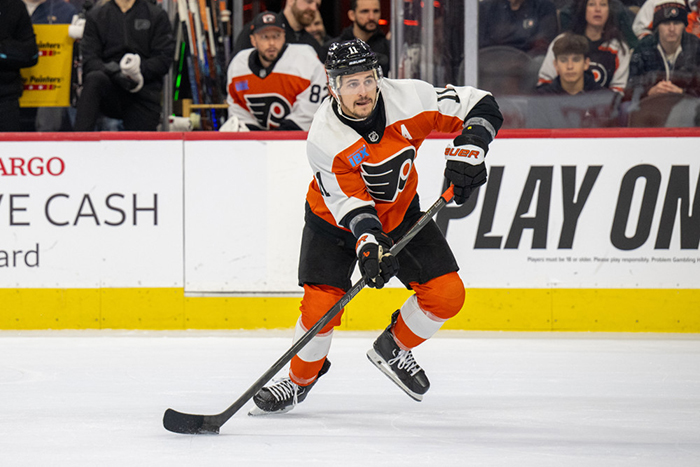
- Philly has too many forwards to pass up open shots looking for back-door slam dunks. Travis Konecny is the No. 1 culprit but he has plenty of company. Moreover, the Flyers miss the net too often when there’s a shooting lane. Alternatively, they wait too long to pull the trigger. The lane disappears and the shots get blocked.
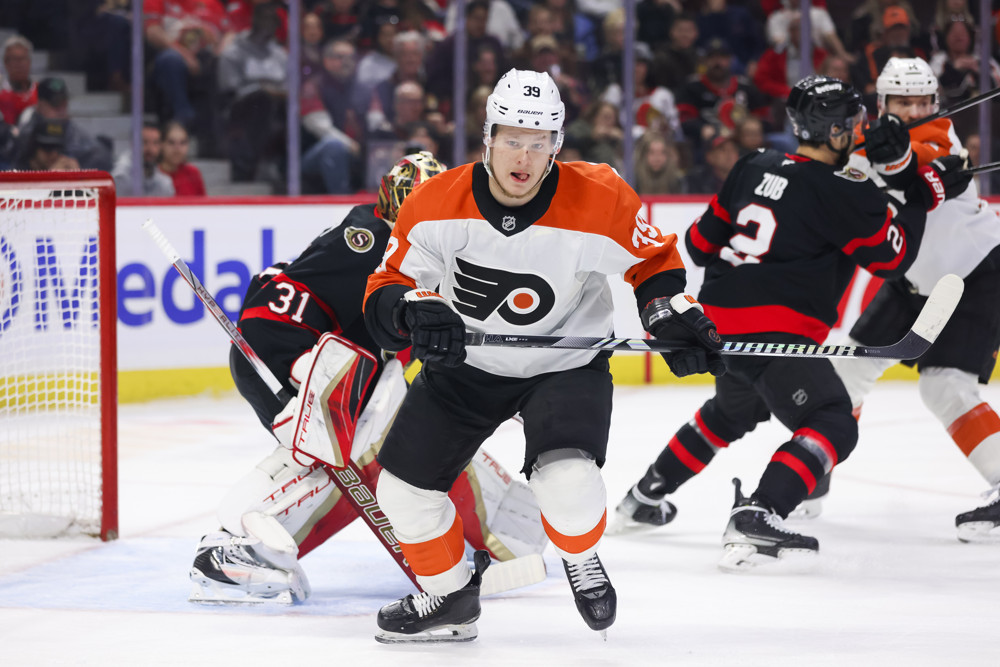
- Philly’s blueliner corps has done more than its fair share to contribute goals (across all situations). Unfortunately, the forwards have failed to do their part. Only three Flyers players have scored more than one playoff goals to date. Two are defensemen (Jamie Drysdale and Travis Sanheim). Only one is a forward: Porter Martone. However, the 19-year-old Martone is now pointless in his last five games. Thus far in the Carolina series, he has just a couple “almost plays” to show for two games.
- Meanwhile, the Flyers desperately more than almost plays from Konecny, Trevor Zegras, Matvei Michkov and company. Michkov at least was a bright spot in the otherwise gut-wrenching overtime.
- Ultimately, the Flyers don’t just need situational goals. They need goals, period. Zero regulation goals in Game Six against Pittsburgh and outplayed in OT until Cam York’s series winner. Shut out in Game One against Carolina. Quick start in Game Two and then blanked thereafter despite a lot of power plays and controlling the overtime.

We’ve changed players, coaches, systems, as long as the PP is at the bottom of the league we’ll never be a legitimate contender.
If Zegras shot the puck he’d fool everyone and potentially score. Once he touches the puck in the offensive zone the Canes players back away from him and close the passing lanes. The goalie even cheats for the pass. Everyone knows he’s not going to shoot and is looking for a pretty play.
Right now they’re going through a 4-5 game clinic on what it takes to truly compete in the playoffs. Hopefully the young kids learn the lessons being taught.
Going forward, the Flyers do have a few shoot-first types on power plays: Martone, Foerster, Bump. In the short term, though, they are still way too pass first. Foerster HAS to be a flank threat. Martone HAS to be a net-front to slot threat.
This is what I tried to post yesterday:
Looks like Glendening will be tired after tonight’s game.
It’s too bad the NHL needed to have a game Saturday night. An extra day (or two) would have been welcomed for recovery time.
I would like them to be told that if you have a look at the net between the dots, shoot the puck on net.
On the powerplay, if you’re part of the umbrella, position yourself for a one-timer and take it when you get it. More movement from the bumper and down low forwards wouldn’t hurt. Obviously, not as simple as this, but you gotta start somewhere.
And, most importantly, on an odd-man rush, unless there’s some unbelievable defensive play, if you don’t get a shot off, I’d kangaroo court fine the player’s involved. (Hathaway may end up owing more than his salary)
They don’t have a particularly complicated power play structure, especially since they took plays out down the stretch. It comes down to executing, and they don’t.
The Flyers over pass on the PP and they keep to the perimeter too much. They try too many shots from impossible angles. I wouldn’t mind seeing more shots from the point with traffic in front. Right now Risto seems to be the only guy willing to shoot from the point. It would also be nice if the Flyers actually hit the net with their shots. Lately they have been missing everything. I wonder how good this team might be if they had a decent PP? Do you think Yogi gets replaced as the PP coach?
Those are all clear issues: No consistent point threat, no left flank threat who hits the net consistently (when healthy and on his game, Foerster can). Eventually, Martone should be consistently parked net-front.
In terms of lacking a point threat, other clubs just about dare Philly to beat them from the point.