
Therien’s Take is powered by Phans of Philly, by Lights On Electric, by New Balance of Mount Laurel, by Cover All Exteriors, by Summit Public Adjusters and our newest sponsors, The Mens and Boys Store and Carl’s Cards and Collectibles.

I’ve been a big pro wrestling fan for years. To be honest, I don’t really follow the business much these days. However, I used to enjoy watching WWF/WWE, WCW, and even the Philly-based ECW.
Al Snow was never a major start on the national level. He was a mid-card performer in various promotions. Later, he became a successful trainer, promoter and booker. He’s a bright and articulate guy. He’s also never been shy about sharing his opinions.
That leads me into this week’s edition of Therien’s Take.

Hockey is nothing without fans, but…
Let me put this out clearly. Hockey fans are a passionate crowd. That’s a good thing. Without you, there would be no such thing as pro hockey. I love hockey fans in general and Flyers fans especially. You made it possible to live out my dream of playing the sport I love for a living, and your support means the world to me and to everyone in this business. Thank you all, from the bottom of my heart.
Accepting criticism is part of the job in any profession that plays out in the eyes of the public. Boos and cheers are ways that fans show they care passionately about a team. If you can’t live with some criticism as a player or a coach or a GM or even as a hockey broadcaster or writer, you’re in the wrong line of work.
This does not, however, give free reign for the hipster analytics “experts” to direct snarky disrespect at the people who actually work within the sport. Those whose work in NHL analytics departments don’t do that; they simply try to help provide info snippets the hockey staff can use or discard as they see fit. Theirs is a respectful relationship; quite different from what goes on as in social media and hockey message boards behind the “bravery” of anonymity.
… hockey smarks are often clueless
As such, my final thoughts this week are specifically directed only at the segment of the analytics cultists that you could deem “hockey hipsters”: a small percentage of fans, largely (not entirely) comprised of Millennials. They seem to think that, by harping nonstop on analytics buzzwords, they possess a deeper knowledge and understanding of hockey than the people who actually work within the game as coaches, scouts, general managers and players.
They thrive on constant negativity. They are convinced they know more about the game and the business than people who are IN the game.
News flash: They don’t. The vast majority, when pressed accidentally reveal just how little they actually know.

Opinion (and no context) stats do not equal knowledge
Al Snow talked eloquently about the influence of “smarks” – that industry’s equivalent of the hockey hipsters – and how much stock those who work within the business should put in their criticisms and praises. His words apply just as readily to hockey hipsters as smarks, so I’ll quote the most relevant portion verbatim:
“[Fans] tell you whether you had a good match or not, yes or no? They’re entitled to their opinion, are they not? But it is just an opinion, and what is an opinion? It’s the lowest form of human knowledge. So now you went out and tried to perform to the standards of someone who has never once done what you are doing to try to make a living.
“To prove my point, doctors attend school for a minimum of, what, seven years. After they graduate medical school, are they immediately a doctor? No, they have to now go through residency for another three years. What is residency? Residency is where the doctor gets experience, hands-on experience, coupled with the information they’ve learned in college to where, only then are they allowed to be called a doctor. That’s how important experience is.

“If you got hurt, would you tell a doctor how to fix you? Why not? Because you’re not a doctor. If the doctor listened to you, what would he be? He’d be an idiot. Now explain to me why you are allowing other people to tell you how well you did, who have never done it?
“I love medicine. Love it. Have an obsession with it. I watch every medical show that’s ever been on TV. I watch ‘House,’ ‘E.R.’, ‘The Doctors,’ “Dr. Kildare’, ‘M.A.S.H.’, you name it. And I go on the internet every day. I google my own symptoms and I even go on the New England Journal [of Medicine], every day. Should I ever tell the doctor how to fix me? No. Why? Because I’m not a [bleeping] doctor.”
“…You know who came up with the term ‘smart marks”? Smarks. Why? Because they have a bit of information that they now feel like they are part of the inside of a business they have never been in, and they want to differentiate themselves and say they’re not just fans. …Do you base your performance on what their opinion is? Don’t.”

The same thing applies to hockey. There’s a proliferation of people who know just enough about the game to convince themselves of their “expertise”.
The reality, the more someone knows about hockey, the more the person realizes how much is unknowable. Much of our game comes down to chance.
The longer someone has actually been around hockey, the more humble the person becomes. Why? Because that’s what real-world experience brings.
That’s true for players. It’s true for coaches. It’s true for GMs. True for scouts. Meanwhile, it’s also true for people who are professionally employed in analytics (they look for patterns and percentages, NOT some sort of higher wisdom).
“Mister Hockey” himself, the immortal Gordie Howe, was extraordinarily humble. Why? Experience. Hockey reinforces humility.
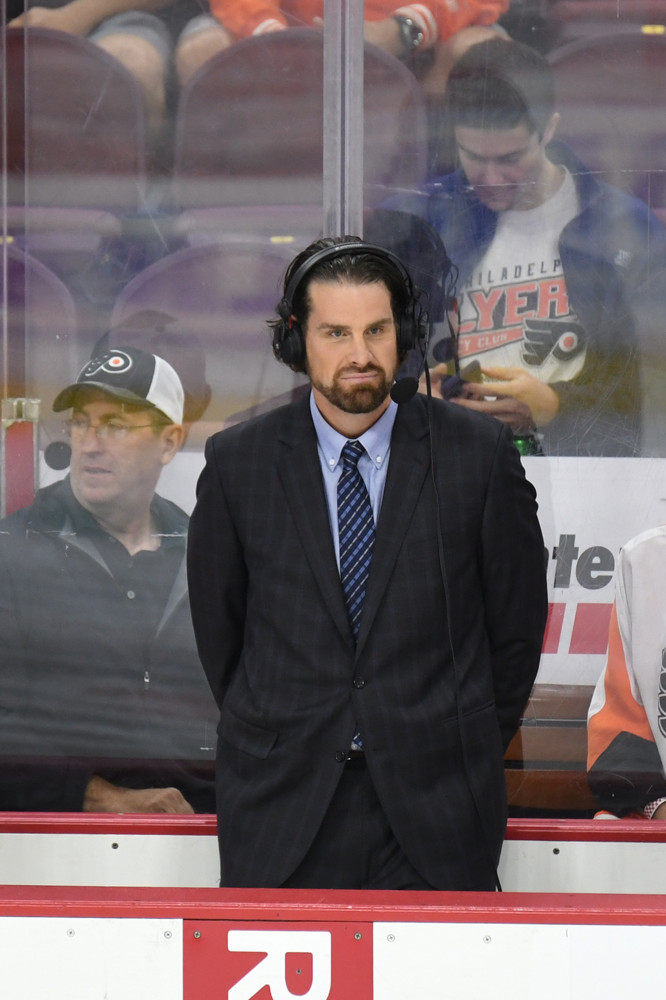
There are hockey fans and flyers fans
Flyer fans in their own world and mostly oblivious the rest of the nhl